Sequential gearboxes
Tuesday, Jul 21, 2026 · 3192 words · approx 11 mins to readI left any mention of the sequential gearboxes that can come fitted to Sevens out of the initial look at the specification of C7 GPU on purpose, in order to write about them in more detail in a big reveal a bit later, but mostly gave the game away when writing about my interactions with various folks in the Seven community.
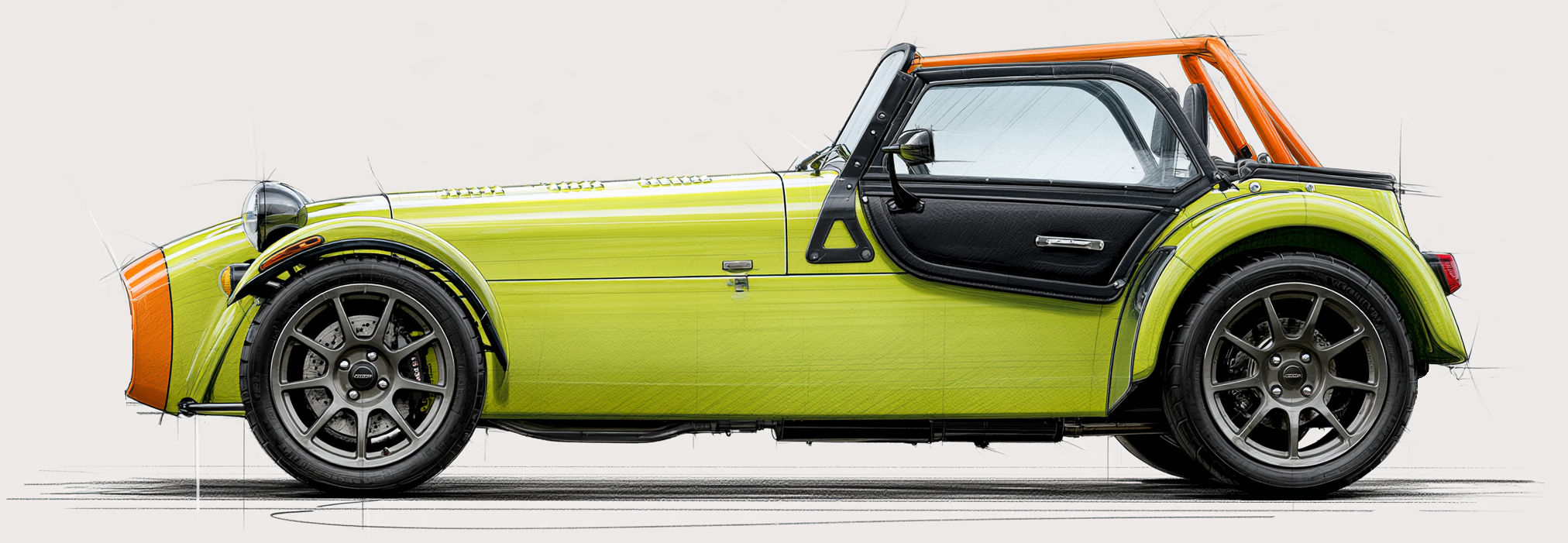
My car has the Sadev SCL82-17, which normally only comes fitted to 620Rs as a standard part on those cars. Otherwise, outside of 620Rs, it’s only available on a road car as part of what Caterham call their “Signature” personalisation program.
When you buy and specify a new car from the factory, you can request they go off script a bit and give you the ability to make further changes to your car’s specification that aren’t part of the standard configuration options that all customers have access to, under that Signature banner. Most of the things you can ask for that Caterham will acquiesce to are cosmetic, such as your favourite unique paint colour, but the changes also extend to the mechanicals.
The number of non-620R road cars with the Sadev SCL82-17 from factory isn’t completely clear, but it’s vanishingly small in the grand scheme of things. I know of just a handful, mainly three S3 chassis cars—Simon Hoade’s red 420R, a Viper blue 420R that’s currently for sale at the time of writing, built by Simon Bennett, and a British Racing Green car built by Ben Scammell that has a 260 bhp Cosworth 2.3L motor and which he badges as a 540R (not an official Caterham model designation but somewhat deserved because of the motor!).
The fourth car I’m aware of is mine, the original owner adding it to the car as part of the original factory build using the Signature personalisation program. That lack of choice was why I jumped on this particular car, because to get access to a Sadev gearbox in a Seven outside of a 620R or 420 Cup, and in a factory-built SV-chassis car no less, is about as difficult as it gets. I think it’s unique, given all race 420Rs with the gearbox, and all roadgoing 420 Cup cars, have an S3 chassis.
So while there are myriad 620Rs available, including a healthy supply of SV-chassis cars for a larger gent like myself, it wasn’t the way to a sequential gearbox for me. I test drove a 620R as part of the selection process and, honestly, it was too much for me as a road car.
I like to think I’m comfortable driving faster cars, but I know my limits, especially on the road, and the performance of the (admittedly a good bit healthier than stock) 620R I tried was a bigger bite than I’m currently hungry for. The supercharger would also dominate the driving experience in a way that doesn’t appeal to me. These days I’m much more interested in the responsiveness and adjustability of a high-revving naturally-aspirated motor, and love my Clio 182 Cup for that aspect of its powertrain. I want that aspect in any Seven, which also takes 620Rs off the table as an option, aside from their truly ballistic supercar-shaming performance.
There’s also another gearbox option outside of the Sadev SCL82-17 for Sevens: Quaife’s QBE60G. The QBE60G can be found fitted to a small number of factory-built Superlight R cars, all S3 chassis from what I can make out, along with a small number of CSR-chassis cars. The CSRs are often the stonking CSR 260, which features a 260 bhp Cosworth 2.3L (very similar to what’s fitted to the BRG car built by Ben Scammell).
It’s actually a 2009 CSR Superlight with that same 260 bhp 2.3L Cosworth motor that caught my eye back when I was working out what to get this year. I’ve just checked if it’s still for sale at the time of writing this and it is, and it still blows me away how good it is on paper: the aforementioned Cosworth motor in a highly-desirable CSR chassis with its inboard front and independent rear suspension, dripping in tasteful carbon fibre including an aero screen and Tillet seats, in a gorgeous colour, with modern dash layout. The Quaife gearbox perfectly tops off what’s already an excellent example of the very best of a Seven in my opinion.
I showed Simon Hoade that particular car while I was on my search and he shared with me the tell that it’s a Quaife-gearboxed car: the shifter lever under the silver knob has a red anodised aluminium collar for the neutral lockout, whereas on Sadev-equipped cars the lever and knob are both black.
And while both are 6-speed sequentials, there are differences in their behaviour and construction that are worth understanding if you’re thinking about buying a Seven with one like I was, if you consider the sequential gearbox to be a key part of the overall package that you don’t want to do without.
But first, a high-level overview of how both gearboxes, and sequential gearboxes of their type in general, work. In both normal H-pattern and sequential gearboxes, all of the gears are spinning at all times, and when you select a gear, what you’re doing is using the shift lever to choose a gear to engage with both the input and output shafts. The differences lie in which gear you can choose next, and the design of the gear rings and how they’re engaged.
In a regular H-pattern manual gearbox, after you disengage the clutch by depressing the clutch pedal you’re free to choose any other forward gear in the gearbox, or shift into neutral. In most gearboxes of that type, there’s another small clutch in the gearbox itself which engages a fine-toothed synchroniser ring with the gear you select, which matches that newly selected gear’s speed to the speed of the gear it will connect to on the output shaft. That synchronisation happens before you release the clutch pedal to reengage the clutch that reconnects the engine to the gearbox’s input shaft, transferring the engine’s power and torque into the gearbox again to keep the wheels turning.
That synchronisation makes for smoother shifts, because the gear speeds are matched before they engage in the gearbox, and before you then reengage the main clutch, both of which significantly increases the life of the gearbox by reducing wear on its gears. These days on a modern car the gearbox should last for the lifetime of the car, well past 100,000 miles. You can hopefully picture how that reduction in wear to make it last a lifetime comes about, with the gearbox input shaft unloaded before the sychroniser makes sure the gear speeds are matched so their teeth can gently engage.
However, that sychronisation process adds a bit of time to each shift in exchange for those benefits in smoothness and mechanical wear, and during that time there’s also no power being transferred from the engine to the driven wheels because you’ve also disengaged the main clutch. That change in power through the powertrain can unsettle the car if you’re not careful.
In a sequential gearbox, you do away with the synchronisation hardware and the need to disengage the main clutch when shifting. Instead, while engine power and torque is still being fed to the gearbox, you can still shift gears. But how?
Rather than a fine-toothed synchroniser ring, each gear has much larger lugs on the selector side of the gear ring, called dogs. When you move the gear lever, the force of that shift turns a camshaft in the gearbox, which in turn moves the gear selector forks to move their selector rings to the next gear. The gear ring’s big (and therefore much stronger) dog lugs slip into the corresponding large spaces in that selector ring (also called the dog ring), while the gearbox is still loaded by the engine with the main clutch still engaged.
The large dogs on the gear, and the receiving dog ring, are strong enough to transfer the forces still being fed into the gearbox from the engine to the output side, while they’re partially engaged with each other. That’s what enables you to shift without the clutch, because the dogs will find their home in the dog ring very quickly. As you can imagine, that shift speed, and because the gearbox is still being fed power and torque by the engine while it happens, the shift is much more mechanically violent.
The speed of the shift is therefore important, and the faster the better. That’s because you want to minimise the amount of time the gear and the dog ring are slipping past each other before fully engaging. They can’t help but do that for a brief amount of time, which wears both the dogs and the receiving bits of the dog ring.
That means there’s nuance to operating a sequential gearbox, and things both you the human and the car’s electronics can potentially do, depending on the capabilities of the gearbox and said electronics.
The main objective, whether it’s via your control of the shift and the car as the human, via the gearbox design—both the Sadev and Quaife have design features along these lines—or from the car’s electronic control of fuelling and ignition, is to very briefly reduce the load on the gearbox from the engine during the shift, to allow for more mechanical sympathy and for the dogs and dog ring to more easily engage without the need for a synchroniser.
The Caterham’s engine management electronics can help with that. It works in concert with the gearbox shifting hardware, sensing what gear you’re currently in along with any partial load you’re applying to the shift lever, to work out when you’re about to actuate a shift, very briefly cutting engine ignition during it, and only restarting ignition when the gearbox tells the control system that the new gear has been fully selected. You might sometimes see that ignition-assisted shift called a flat shift.
Without that ignition control for flat shifting, both Quaife and Sadev strongly recommend you lift very briefly before actuating the upshift instead in order to achieve the same goal. Both the SCL82-17 and QBE30G gearboxes have a design feature to help with that, with an adjustable detent on the selector cam that is turned when you pull the lever. You pull the lever partially to load the shift against the detent wheel, before the load is released to turn the selector cam. When when you lift off the throttle briefly the resulting shift in engine load moves the shift past the detent and the shift continues using the load you’re applying to the lever.
On the Caterham, the helpful ignition cut only happens on full-throttle upshifts, which are the ones that you presumably want to bang in as quickly as possible, so it’s recommended you lift slightly instead during part throttle upshifts, after loading the shift up against the detent.
Then when it comes to downshifting, the advice from both gearbox manufacturers is that you briefly dip the clutch before shifting. You don’t need to fully disengage it, just very partially dip. That partial dip also reduces the load on the gearbox from the engine like the ignition cut or partial throttle lift does on upshifts, and allows for a similar mechanically sympathetic downshift via easier engagement of the dogs in the dog rings.
Both the Sadev and Quaife gearboxes don’t prevent you from up or downshifting without reducing that load, though. You can just merrily bang in the next shift at any speed, without the clutch, but doing so significantly increases the wear on the dogs on the gears and the receivers on the selector rings.
That brings me nicely to servicing. The lack of synchronisation and use of dogs for gear selection mean the dogs are a wear item in a sequential gearbox. Metal will come off into the gearbox oil as a natural consequence of how that kind of gear selection works, so you’re encouraged to service the gearbox regularly by changing its oil.
That’s much simpler on the Sadev, because the drain and fill ports are located on the gearbox housing in more easily accessible places in Caterham applications. If your Seven has a Quaife gearbox and you want to service it yourself, it’s likely you’ll end up cutting a port in the transmission tunnel to give you access to the fill plug on the side of the gearbox housing. On the Sadev, the drain plug is nicely placed on the bottom of the housing, accessible easily from underneath the car, and the fill port is on the top.
In terms of change frequency, Quaife recommend you change the oil completely once per race season, or after 24 hours of hard racing use. On road cars with a less hard life and the occasional track day, changing the oil completely every few thousand miles or at the end of the year when you put it away for the winter is the normal guidance. On both variants the drain plug is magnetic, so you can get a sense for the amount of metal that has worn off. After seeing a certain amount of that, or every 3 years even if you’ve managed to really look after it and there’s minimal metal showing up at every oil change, it’s recommended that the gearbox comes out of the car and gets a full service, opening it up to replace gears and selector rings.
If you’ve gotten this far you might wonder why you’d even want a sequential gearbox in the first place on a car that’s primarily for road use. The service intervals alone would put many off, and the extra work you have to put in as the driver when shifting would put off a great many more. I admit that the service intervals are a pain but, for me, the extra driver involvement in the shifting process is actually part of the magic of driving a car with that kind of gearbox.
Just as a lot of drivers enjoy their part in shifting in a regular H-pattern car, which I certainly do myself, the feeling you get from well-executed shift in a sequential gearbox is just as satisfying, and for me it’s even more involving. I love the extra noise the gearbox makes, chuntering at low speed and noticeably whining under the various loads it experiences. It’s an improvement to the NVH for me, not a downside. I also love the positive mechanical feel from the shift mechanism, and that I have to be deliberate and precise in the action, similar to how I have to be precise in the motion of shifting in a H-pattern car.
There’s a racing car feel to it which I thoroughly enjoy during spirited road driving. The clunking at low speed when pulling away is a reminder of the thrill that’s about to come when executing a full-throttle flat shift, or when braking and setting the car up for corner entry, downshifting after precise clutch dips and throttle blips in perfect sequence.
The extra engagement you get from that, in addition to the Seven’s other major positive attributes of no driver aids in braking or traction control, and no power steering, all in a car that’s super light weight and exposes you to the elements, is an integral and foundational part of the magic of a Seven for me.
In terms of final major differences between the Sadev and the Quaife, outside of their limited availability on various Sevens, there’s not too much. Apparently the Quaife is a bit noisier and clunkier. That’d be absolutely fine by me! Weight-wise, the Sadev is 30kg and the Quaife is 38kg, and if you think the Quaife is somehow overly heavy in comparison, both are significantly lighter than both the original 5-speed Ford Type 9 gearbox that Sevens used to come with, at 72kg, and the more modern 6-speed gearbox from Mazda at a more spritely 45kg.
Ultimately there’s not much to choose between either gearbox variant and I think I’d love either. If somehow the 420R fell through, I’d just try and pick up the red CSR 260 that I mentioned, or a similar CSR 260 with the Quaife, and I think I’d be just as happy. Maybe even more so given the extra potency of the motor, and the sophistication of the rear suspension in CSR cars. The original plan was to try and get the red car, but the dealer was completely unresponsive when I enquired about it, and I chose to pass on it as a result.
There’s quite a bit more to both of the sequential gearboxes you can get with modern Sevens than my basic explanation of the shifting mechanism and some of the servicing and driveability aspects of the two models that I’ve explained above. If you want to learn more I suggest watching Quaife’s own explanation of how sequential transmissions work and what they’re like to operate and live with, and then their explanation of how the QBE60G works, and take it from there.