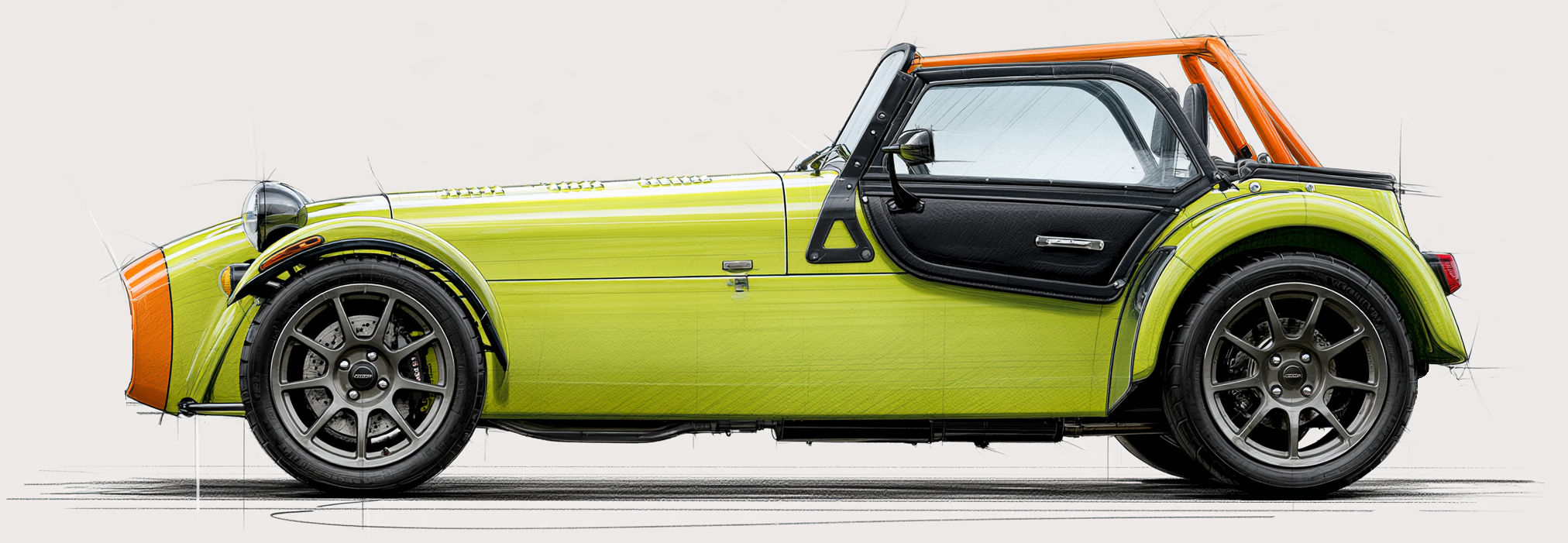
The Caterham Seven community
Tuesday, Jul 21, 2026 · 2693 words · approx 9 mins to readOne of the major reasons I’m so into Sevens is the extended community that exists around the car. Many owners are very passionate about both their own Sevens, and the car and marque in general, and they share that, encouraging each other and sharing their experiences, and frequently getting together with each other at meets, track days and the like.
The biggest embodiment of the community is the Caterham & Lotus Seven Club, a large member-led organisation centered around the excellent website that they publish and maintain, but which expands out from there. It’s a thriving owner’s club that tried hard to have its members interact and spend time together, organising many community events across the whole year that get members together, ideally with their Sevens, as often as possible.
While the Club is UK-centric, it also has worldwide reach, and the jumping off point for getting involved is its excellent website. It’s the Club’s gateway to a staggering amount of information about Sevens, so if you’re someone like me that loves to research everything in great detail and learn as much as possible, it’s truly amazing.
One of the key things about Sevens that I love stems from the factory-supported ability to build it yourself from a kit. That means there’s a huge amount of information out there about how to put the car together and maintain it yourself, often published by Caterham themselves.
Combine that with the philosopy of the car being as light weight as possible, which is enabled by every Seven’s relative mechanical and electrical simplicity, it means that as a very amateur mechanic that loves learning about everything that makes machines tick, I can not only reasonably work on it myself, but I feel actively encouraged to by the factory. The support on the website from other Club members and the resources made available through it are invaluable in doing so.
Almost every tiny detail about how the car is put together, and how I might want to maintain and update it, has been collated and published by the Club on the website. Members get access to technical material on every aspect of the car, from essential getting started guides through to complete wiring diagrams and engine build specifications. No stone is left unturned in that respect, and I feel confident that if I have the right tools, space and equipment, I could (and plan to!) do almost any job on the car myself.
Not only do you get a breadth of excellent information but there’s a vibrant discussion forum on the Club website called BlatChat, where other Club members get together to discuss their Sevens and what’s going on with them. I’ve found BlatChat’s discussion threads an invaluable resource when digging in to all manner of details about Sevens, and many threads are often hundreds of posts long and contain the collective wisdom of Club members going back over 20 years. Very few online communities have not only survived that long, but seem to still be thriving like BlatChat is.
The website also helps regional pockets of Club members to get together. Almost every area in the UK has a regional group that you can join, and most of those have regular get togethers in the area where you can hang out with like-minded Seven enthusiasts.
Then the Club spends a good chunk of its time and budget organising other community events to get Seven owners together, from circuit and sprint days on track, social-focused get togethers that often include drives, and even European tours.
The next bit of the Seven community I want to write about today is its most important: the incredibly passionate and enthusiastic individuals that give their free time and expertise to help each other out, almost always unprompted and without any expectation of anything in return.
I don’t even have my car yet and I’ve already spent tens of hours discussing the finer details of Sevens, and 420Rs in particular, with multiple very kind and generous people that have been more than happy to discuss Sevens with me at length. I honestly can’t thank those individuals enough, but I’ll give it a go.
Firstly, Simon Hoade, owner of an incredibly special 420R with a particular specification detail that I obsessed over when I was initially learning about Sevens. I’d realised Sevens could be built with sequential transmissions when scouring adverts back when I got seriously interested in them, after realising Audi R8s weren’t for me, including from factory.
So I did what everyone does these days and had a look on YouTube to see if there were any videos on Sevens with that kind of gearbox, leading me to Simon’s excellent channel, Niknak Motorsport. His 420R has a factory Sadev SCL82-17 gearbox and he’s made several videos about the car with some focus on the ‘box here and there, so I reached out to him over email to ask him some questions about what it was like to live with a Seven with that kind of gearbox on the road and in normal driving.
He got back to me almost immediately with a wealth of information, and it turns out that we used to hang out on the same tech-focused IRC channels waaaay back when in the late 90s and early 00s, and has had a Seven for over 15 years now. I had no idea when I first dropped him a line that he was an old connection from so long ago, nor that he’d know so much about the cars I’d fallen in love with.
We’ve been able to reconnect with Sevens as the major glue (but also computers and tech which we both continue to love and do for a living), and he’s been incredibly generous with his time, helping me in all manner of ways as I’ve researched and learned about the cars in both my run up to buying the car that I did, and since then as I’ve started to work on changes to the car that I know I’ll want and love.
We’ve met up several times in the last few months and he’s been incredibly kind, is always forthcoming with his deep knowledge, is infectious in his enthusiasm for Sevens, and has been a great sherpa through the intricacies and technical details of 420Rs, Sadev gearboxes, and what he sees as the path to getting the most out of his own car.
That knowledge and information has been pure gold for me, because he’s had 15 years of ownership and knows these cars to a deep level of learned experience behind the wheel, and technical detail from being so interested in what makes them tick. It’s let me speed run various changes to my own car that I know will be well worth it, because he’s figured those changes out on his cars and his judgement on what to do has been finely honed.
His current car is beautiful and incredibly well specified and updated from the original owner’s vision, and if I’d seen it for sale on my journey to find my own I’d have lasered in on it instantly. It’s the almost perfect specification from my perspective, Sir Chris Hoy specifying something terrific to start with in the first instance, and Simon building on that in his ownership with an incredibly well judged set of changes that are just chef’s kiss.
I’ll write more about his car in the future and the things I’ve taken inspiration from I’m very sure, and he’s not finished with his own vision for the car yet either. Subscribe to his YouTube channel if you’re at all interested in cars, even if you don’t particularly have a fancy for Sevens.
I know I’ve said this to you before, if you’re reading this, but thank you very much, Simon.
Discussing Sevens with Simon has also led me to talk to a number of other people, both directly and indirectly, who’ve been amazing to talk to as well. Andy Jupp at Partridge Green Motorsport, a local Seven specialist near me who I’ll entrust the bigger jobs on my car to that I can’t do myself, helped me work out what it’d take to transplant a sequential gearbox like the SCL82-17 into a car with a traditional H-pattern ‘box, along with incredibly valuable information on the ins and outs of adding a paddle shift system to any Seven with a sequential ‘box. PGM are specialists in fettling supercharged 620Rs and adding paddle shift systems to those most rapid of Caterhams is something they’ve done many times.
I also spent a long time on the phone with Ben Williams at Meteor Motorsport at Simon’s recommendation, discussing upgraded ECUs and potential additional capabilities that upgraded electronic control might unlock alongside some extra hardware to pair with a sequential shift system, along with other aspects of upgrades to Sevens such as Meteor’s independent rear suspension system.
Simon Rogers, the original founder of Meteor but now doing his own thing at TooFastToRace, is a true magician when it comes to suspension setups for Sevens and the brains behind the system on Simon Hoade’s track-focused car. I’ve spent a long time with him discussing how to upgrade my car’s suspension to better handle the shambles that are my favourite Sussex B-roads. He’s putting together something very special for me there which I can’t wait to try, and his own car is a masterpiece as far as sprint-focused Sevens go. 420kg wet with a Kawasaki H2R bike motor making 290 bhp, and a paddle shift system, it’s a wild animal of a car.
Troy Robinson at Northampton Motorsport has been incredibly helpful when it comes to sequential shift electronics and fine tuning, and upgrade parts and tweaks to the overall powertrain of a 420R. I’ll use Northampton in October to improve a particular aspect of the powertrain of my car and make it even more of a visceral thrill to drive.
Then there’s a friend of Simon Hoade, Nick W. Nick runs a Superlight R500D (D standing for the Ford Duratec engine the car has, since some Superlight R cars are powered by Rover K-series motors, which you might sometimes see written with a K suffix) with a Quaife QBE60G sequential transmission, the other sequential gearbox you see fitted to some Sevens. Sevens with a Quaife ‘box were initially an option for me when I was choosing which car to buy, and is the gearbox on the car that stopped me in my tracks and got me seriously thinking about Sevens, back when I was looking for what I should get instead of an R8.
Nick gave me hours of his time without ever having met me, discussing at length what it was like to run a Seven with the Quaife. I highly valued his time and input because there are some important differences between the QBE60G and a Sadev SCL82-17, primarily when it comes to their road manners and their maintenace and servicing challenges, but also in the kinds of peripheral hardware you sometimes see used with them, and the electronics used to manage the shift behaviours that sequential transmission systems can have.
Then there’s Martin Phipps at Caterham Cars. He’s the company archivist and the person you go to if you want to learn anything about a particular Seven. My car has a very interesting initial history, and has been on quite the journey to becoming the car I’m just a few weeks away from collecting, despite having less than 3,000 miles on the road and track so far.
Martin has helped me stitch that together in a way that I wouldn’t have been able to myself, putting in a lot of his time to research my car’s life and give me lots of very valuable information about how the car started out and was first built by the factory. He continues to work on that with me and has been nothing but incredibly helpful, kind and attentive to what I’m looking for.
There are very few car marques on the planet where someone like Martin is both available in the first place, to help you work out what’s happened to your car since it was first put together, and as friendly, kind and encouraging towards you while doing so. Martin is also the Caterham & Lotus Seven Club treasurer, and outside of his role as the factory archivist he also personally called me to welcome me to the Club as a new member, giving me his personal number to ring if I ever needed anything Club-related outside what we’re working on together as far as my car’s history goes.
Lastly, Jack and Arnie Webb at Jack Webb Motorsport have been incredibly helpful when it comes to tyre selection and what’s possible with more advanced active suspension setups on a Seven, something I don’t think has been tried before by many. While an active suspension setup is not quite the direction I want to go with my car, in part because it takes away a pure analogue aspect of the machine and delegates some of its behaviour to a new computer, and in part because it’s just super expensive, it was very interesting to learn about it and they were very happy to share information about the finer details to help explain it to me.
I’ll write more about my conversations with the Simons, Nick, Martin, Ben, Andy, Troy, Jack and Arnie in future posts, since the information they’ve all given me forms a key part of my technical journey with my car, and could also be helpful to others.
None of them had any obligation to talk to me at any kind of length, but all did, and were or continue to be incredibly generous with their time, expertise and encouragement. As a newcomer to the cars that’s been deeply interested in some of the key technical aspects of what makes a Seven tick, and what it’ll be like to own and enjoy one on road and on track, they and the resources and community around the Club have been incredibly helpful, warm and welcoming.