Initial specification
Tuesday, Jul 14, 2026 · 2373 words · approx 8 mins to readLike a lot of Sevens out there, the car isn’t as it left the factory. It’s really common for owners to take a Caterham-supplied starting point, either as a kit they’ve specified to build themselves, or built by the factory, and use that as a launch pad to create something unique that matches their exact tastes and requirements. Then, as their experience with the car grows, those tastes, requirements and expectations of the car evolve, and the Seven as an overall platform is ripe for modification to keep pace with what owners want.
I plan to fairly heavily change the car during my ownership to have it meet my own personal vision for what the “perfect” Seven is, but it’s worth documenting the current starting point today, as I bought it, and then later the history before my ownership as well, so the full timeline of the car can come together across all of its various ownership spells.
My goal with this blog is to document everything so that I can explain who did what, take some guesses at why the prior owners made their particular choices specifying and upgrading the car, explain my own choices as I do the same, and write down when everything happened.
So, what is the car today at the time of writing?
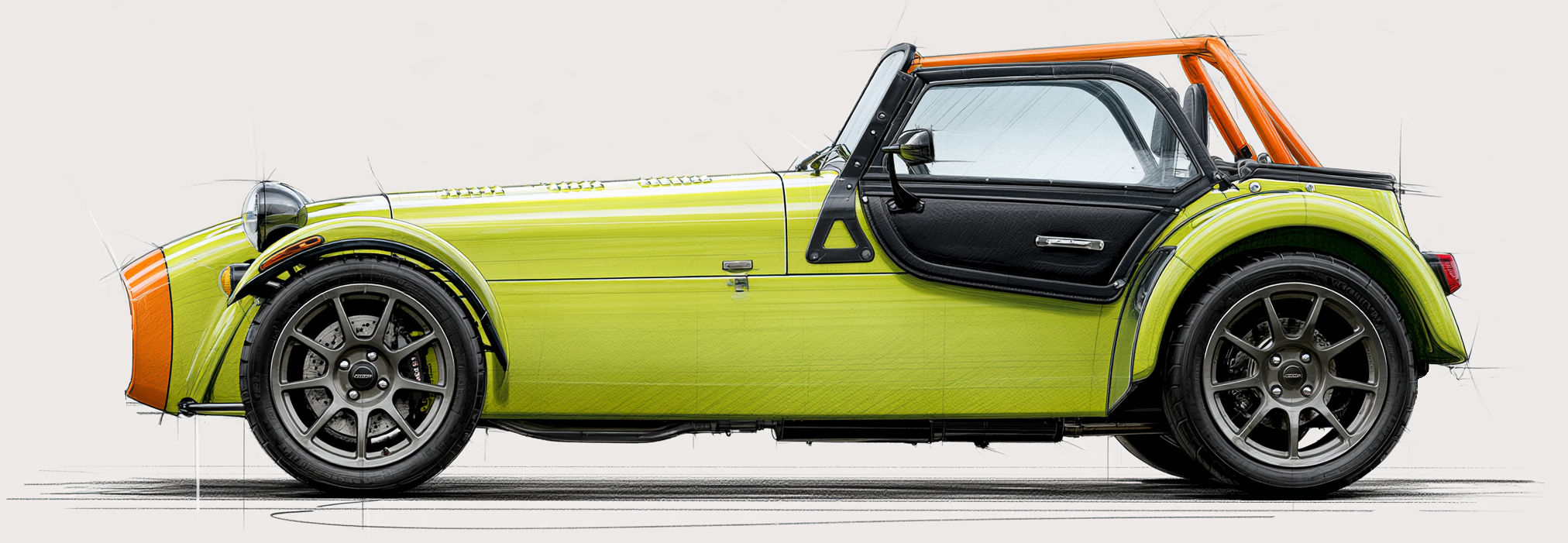
At a high level it’s currently a 2017 built and registered SV chassis car, with a spec that the factory would consider to be a flavour of what they call a 420R, painted Kawasaki green with orange detailing on the nose cone and full roll cage, on Caterham’s anthracite 15-inch Orcus wheels.
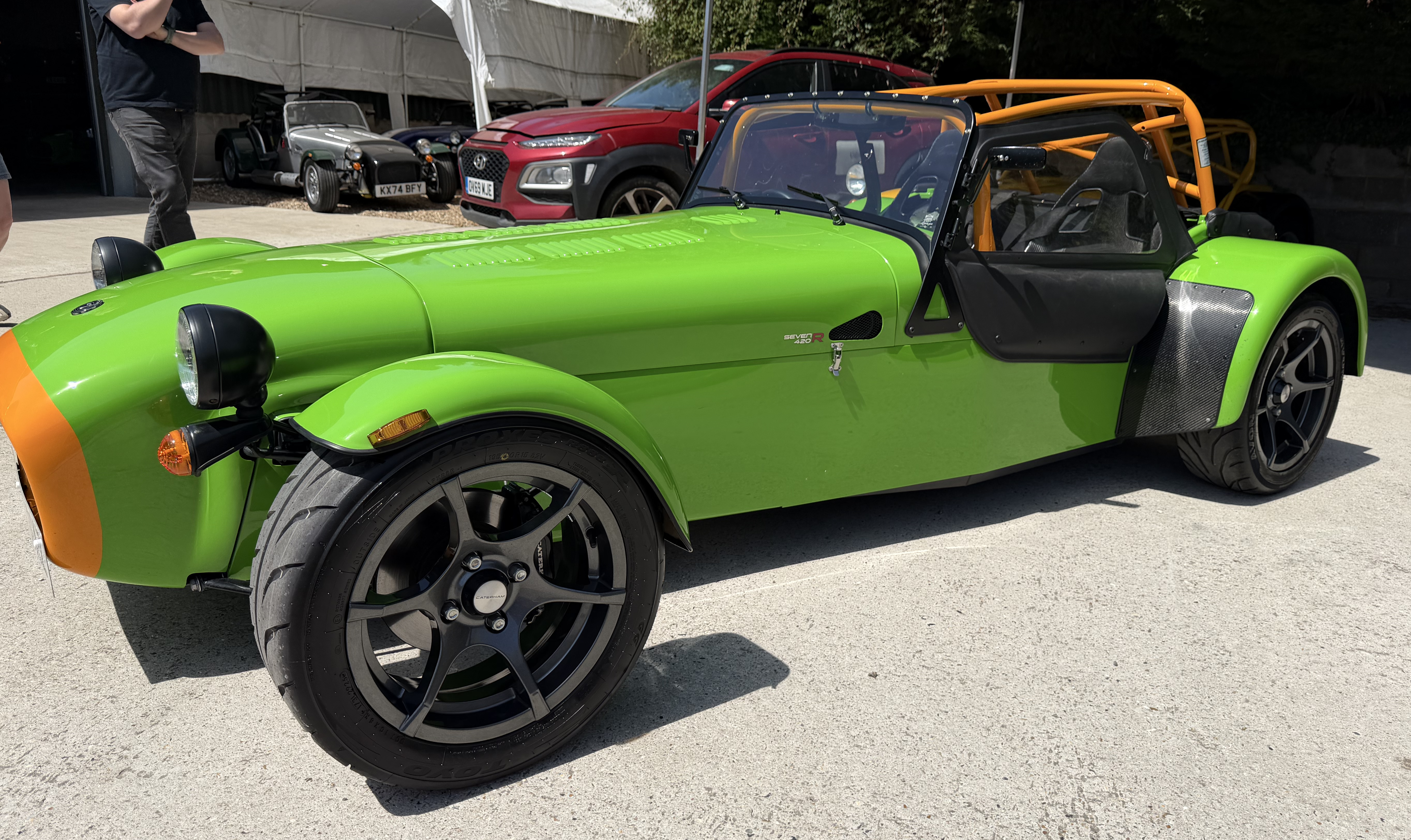
Left side view from the visit to place the deposit - 22nd May 2026
Not quite what you see in the header image of the blog at the moment, but close. I did the best with what little AI prompt engineering experience I have, and needed to use in no small part because I can’t draw.
If you’re not familiar with Sevens, you’ll need a bit of a helping hand with some of the terminology and model naming that Caterham use to describe the cars. The Seven has undergone a number of chassis revisions in its lifetime, which is to be expected given the long life the car has had in its various guises since Lotus first put one together in 1957.
SV, or S5 as you might sometimes see it written, means it has a series 5 chassis or the 5th major revision of the chassis since the initial car all those years ago. There are 3 major chassis revisions in production if you were to order a car today: S3, SV and CSR.
The S3 chassis is the narrowest of the three, and a little bit shorter as well. While I fit in an S3 car, it’s really snug and I’d really need to shed quite a bit more timber to feel comfortable driving one. It’d definitely also need lowered floors, an option you can specify to help taller folks fit (and also lower the centre of gravity a bit). The easiest visual tell whether you’re looking at an S3 or not is, if it has one anyway, to count the number of poppers on the windscreen that are there for attaching the fabric roof. There are 7 on an S3 and 11 on the SV and CSR.
The SV widens and lengthens the body (and thus the overall wheelbase) to make it roomier for folks of my stature, and the CSR (which stands for “Cosworth, Seven, Road & Racing”) retains the same overall footprint of the SV but makes significant changes to the suspension systems at both the front and rear of the car, primarily to make the car ride in a more compliant and comfortable way, especially on fairly awful UK roads.
If I could specify my perfect Seven in every way, it’d be one with a CSR chassis, but that wasn’t an option for me without buying a car brand new and specifying a very expensive modification to it through Caterham’s “Signature” modification program, which allows you to colour outside the lines of the typical specification levels that they offer. CSRs were also originally offered with Cosworth-tuned Duratec motors in some wilder states of tune (2.3L, 260 bhp!), but current run-out CSR “Twenty” models have the same 2.0L 210 bhp motor as the 420 cars.
After the chassis type, the next major thing in Seven nomenclature is the performance level and whether the original buyer wanted more of a road or track-biased specification at that performance level. For my car, a 420R, that means Caterham claim it has roughly 420 horsepower per tonne and has the “R” pack which chooses some default race/track-biased options, such as a dry sump oil system for the engine, LSD, and no carpets.
There’s also an S pack which is much more road biased, and I recommend a trip to the Caterham configurator if you’re interested in seeing more of the difference between R and S pack cars.
As you get to know Sevens, you’ll realise that Caterham play a bit fast and loose with the power-to-weight ratio bit of all of their model names. It’s more accurate on the smaller, and thus lighter, S3 cars, but on all but the smallest engine models they’re still more than 500kg when full of fluids, never mind with driver.
My car should weigh around 570kg wet, given it’s an SV car with a relatively heavy engine, but I currently add another 92kg to that. Assuming all 210 bhp is still available from the motor, we’re at roughly 315 per tonne instead of the 420 in the model number. That’s still a huge amount of performance (around 70% more than my old Golf R, which had a near-as-damnit turbocharged 300 bhp engine).
When it comes to the roll cage, Caterham offer several options when you specify a new Seven, and the first owner of the car picked what the factory called a “Sport” roll cage. That cage type, with “double D” shape for the top-most bars, but no side impact protection bars, isn’t available as a standard option, but Caterham do sell it separately as an “Academy (windscreen)” cage. I believe it’s also called a “Roadsport” cage as well, but it’s hard to tell. Disambiguating all of the cage options has been frustrating! If I was specifying a car myself from scratch, I’d choose the “Race” cage with side impact protection, and might well swap to one of those eventually.
The Sport cage allows for swapping out the windscreen that you can see in the picture above for a smaller aero screen, and although the factory has an option for supplying the wind and aero screens with the car and the first owner ticked that option, the aero screen is sadly no longer with the car. So if I want one (and I do!) I’ll need to source one separately.
Onto wheels and tyres now. Buyers of new cars get the option of either lightweight 13- or 15-inch wheels with completely different designs, and it’s the 15-inch “Orcus” wheels that you can see in the picture above. The car will come with Toyo R888s on the front and Avon ZZSs on the rear, which is annoying, and so even if I did prefer 15-inch wheels over 13s I’d replace the tyres quickly. Instead I’ll replace the wheels with two different sets of 13s, one set for the track and one set for the road. More on that in another post.
The suspension setup for an S3 or SV chassis car is not as sophisticated as what you get on CSR cars, which have fully independent suspension front and rear, and inboard front dampers. Instead of the fully independent rear suspension that CSRs have, S3 and SV cars have a rear suspension architecture that links both sides with a bar, called a de Dion axle.
That means that suspension travel on one side of the car can translate into sympathetic motion on the other side. I’ll discuss suspension at length as time goes by, since while there are distinct advantages to a system like that when the road or track is pretty smooth, that’s not what the roads around where I live are like.
When it comes to the specification of the rest of the suspension, R-pack cars like mine come as standard with what Caterham call “sport” suspension, but the first owner specified the upgraded (although I don’t think I see it that way for a car that I’ll use primarily on the road) “race” suspension instead, and that’s what the car still comes with.
The race suspension has a wider track, the same Bilstein dampers their race series cars have, adjustable spring platforms to allow you to change the ride height front and rear, and significantly stiffer springs than the “road”, “track” and “sport” suspension options. Combine those much stiffer springs with the de Dion rear suspension and, well, I won’t stick with the stock suspension for very long. It’s too track focused and just isn’t going to be suitable for Sussex B-roads.
The first owner also specifed “aero” wishbones for the front suspension too, which swap the standard spherical wishbone construction for ones with a more tapered leading edge that look like they should cut through the air a bit better, but with the outboard front springs and dampers sitting directly in the middle of them, completely on show, I doubt it makes the blindest bit of aerodynamic difference. They look nice though, and were only a £350 including VAT upgrade back in 2017, looking at the original order sheet. That same option is £900 now.
Stopping the car is taken care of by yet another non-standard option the original buyer specified at order time: upgraded 4-piston caliper front brakes with ventilated discs, made by AP Racing, with an uprated brake master cylinder. The car is so light that the brakes don’t have to be very high powered, but the increased stopping performance is welcome given the overall performance of the car.
One thing for me to get to grips with will be the lack of servo assistance and lack of any electronic anti-lock system for the brakes. The original owner also had a brake bias adjustment system fitted, something the factory doesn’t offer, that lets you adjust the front-to-rear bias of where the hydraulic pressure goes when you give the car a brake pedal input.
That’s most commonly done to make the car less rear-biased when on the brakes, and to be able to dial in maximum stopping power from your chosen discs, pad material, caliper setup, tyres, and driver preference and feel. That fine-tuning allows the driver to setup the system to be able to brake hard without locking up on either axle, no matter the setup.
Everything about how the car goes, stops and turns will be entirely up to my human inputs since there’s no power assistance on the steering either. Really there’s very little going on electronically with the car outside if the ignition, fuelling and temperature management systems.
One last major detail worth writing about in the initial specification are the beautiful carbon fibre seats made by Tillet. Gorgeous to look at and great to sit in, they’re only lightly padded but were really comfortable on my test drive, and the first owner specified them with 6-point racing harnesses to keep me and any passenger securely strapped in.
That brings me to a bash at writing the major specification out, as it stands today, to refer back to later as I make changes:
- Caterham Seven 420R SV (2017)
- 2.0L I4 N/A Ford Duratec, 210 bhp
- 15” Orcus anthracite alloy wheels
- Avon ZZS rear, Toyo Proxes R888 front
- Race suspension pack
- Adjustable Bilstein dampers
- Rear anti-roll bar
- Aero wishbones
- Dry sump oil system
- Limited slip differential
- 4-piston AP Racing front brakes
- Standard rear brakes
- Brake bias adjustment (non-standard)
- Uprated master cylinder
- Sport roll cage
- Heated carbon fibre Tillet seats
- 6-point harnesses
- Momo quick-release steering wheel
- Plumbed in fire extinguisher
- Lowered driver and passenger side floors
- Heated windscreen and full weather equipment
- Carbon-effect vinyl boot cover
- Battery master cut-off switch
- Carbon fibre R-pack dashboard
- Rev shift light system