First planned modifications
Monday, Aug 03, 2026 · 2635 words · approx 9 mins to readI don’t even have the car yet but I’ve already planned out the first modifications that I’ll make to it in my first year or so of ownership. You might think it a bit silly to want to change the car before I’ve even spent significant time behind the wheel, but the benefit of the Seven having such a long and well-documented history is that figuring out what works and what doesn’t is often a simple matter of immersing yourself in the learnings of other owners in order to pick up their hard-fought wisdom, often over decades of ownership across many kinds of Seven.
There’s such a huge amount of information out there to draw from, and the community is such a fantastic resource in all of its forms. Whether it’s reading the Club forums, talking to other owners, looking at other cars at meets, or even just browsing pictures on Instagram or videos on YouTube, there’s so much information out there to sponge up and absorb. I’m the kind of person that naturally wants to research everything and learn as much as I possibly can about a given topic, so it’s almost the perfect car for someone like me.
That research has led me in three very strong initial directions with early changes I want to make, where I already know that Caterham and the prior owners’ choices for the car aren’t going to suit my needs and how I’ll drive it.
The first two are related, so I’ll cover them together: wheels and tyres, and suspension. You should often think of the wheels and tyres on a car as an integral part of the suspension, and part of why I want to change the wheels and tyres the car comes with is to make changes in that area.
If you picture the way a car is suspended by its suspension hardware front and rear—which applies to any car, but it’s particularly easy to visualise on a Seven because on most cars the suspension hardware at the front is directly on show—you can see that there’s parts of the car underneath the spring(s), and parts of the car above. It’s common with cars to say that everything above is the sprung mass or weight, and everything below is unsprung.
And on a car like a Seven where the weight of the entire car is the primary factor in its overall performance, the unsprung weight is particularly important when it comes to the overall handling and dynamics of how the car feels to drive. Taking any weight out of that unsprung hardware in a Seven is therefore going to result in a car that’s more agile, more responsive to steering inputs, and gives the suspension hardware an easier job to do in managing the overall kinematic behaviour of the whole car, both in what’s happening below the spring(s) and therefore what then happens above.
You should also always consider tyres as a suspension component. As a car travels over any surface that isn’t perfectly flat and smooth, when the car moves over any bump and the suspension compresses to absorb that bump, the tyre is actually what compresses first. In talking with Jack Webb Motorsport about tyre choice for my car, I learned that typical tyres suitable for the Seven have an effective spring rate of about 200N/mm at recommended air pressure. That means 200 newtons of force will compress the tyre by 1mm, which makes the tyre the first (admittedly very stiff) spring in a car’s suspension setup. By comparison, a typical spring rate for the main spring in a car’s suspension will be around 50-100N/mm.
So the main goal with wheels and tyres on the Seven is to make them as light as possible, since they’re a major component of unsprung mass. It’s hard to really consider the tyres as a suspension component because, as discovered, the spring rate of the tyre and the super low weight of the car mean that they’re barely acting as a spring at all in a Seven, except on very bumpy surfaces.
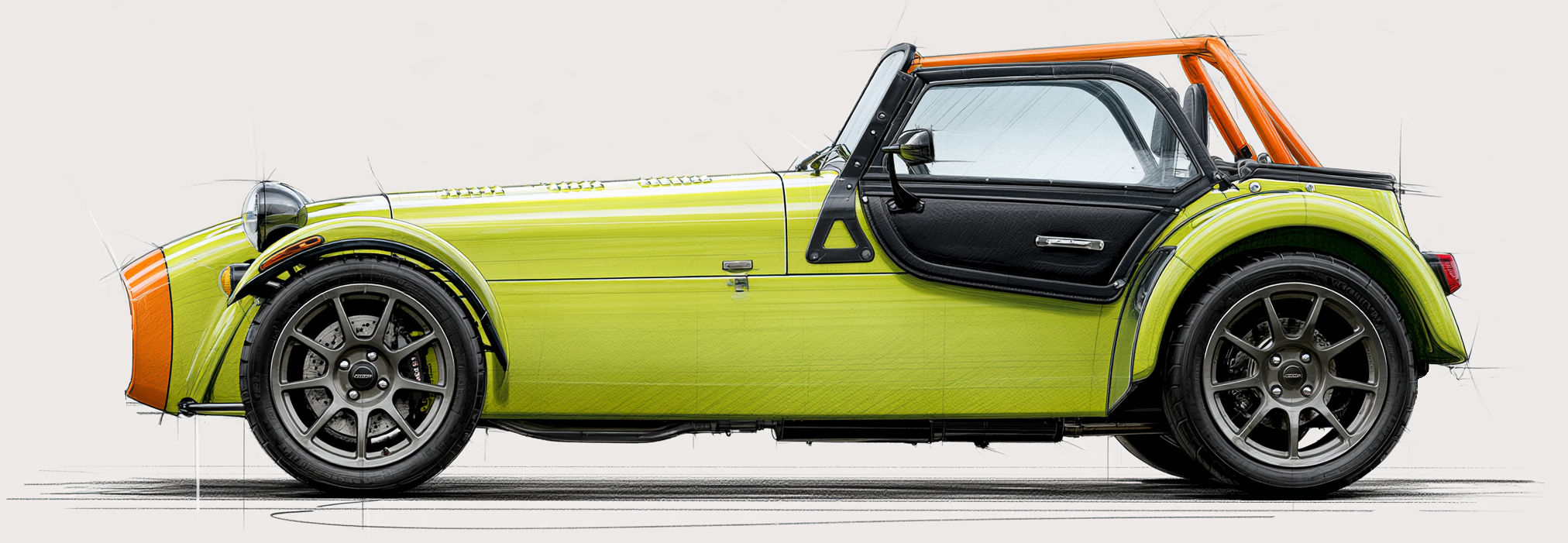
To explore any benefits in changing things, let’s see what the supplied wheels and the tyres on the car weigh, so we know our starting point. The 6.5x15” Caterham Orcus wheels weigh 5.9kg each and they’re that size all round. The car also comes with a pair of 195/50 R15 Toyo Proxes R888R on the front, each weighing 8.6kg, and a pair of 195/50 R15 Avon ZZS on the back, each weighing 7.0kg, giving us 54.8kg for the combined wheel and tyre package the car will start with.
For road use I’ve bought a set of BBS 13” wheels from Westermann Motorsport, 7” wide on the front and 8” wide at the rear. The fronts are 4.8kg and the rears are 4.7kg (yep, the fronts are heavier than the rears, despite being narrower). That gives us 19.0kg for the wheels.
Then depending on the tyres I pick, which I’m still not quite sure about, the narrower front rubber will weigh anywhere between 6.7 and 7.3kg, depending on the exact tyre, and between 7.9 and 8.7kg on the wider rears. At the upper end of the possible tyre choices, the total weight including wheels would be 51.0kg, saving 3.8kg of total unsprung mass, and at the lower end it’d be 48.2kg, saving 6.2kg of total unsprung mass.
3.8-6.2kg might not sound like much, but as I’ve discussed before, every little helps when the car weighs so little to start with. A similar saving of sprung mass can also be had just from swapping the standard battery for a lightweight lithium nano-phosphate one.
I’ll talk about my tyre choice a bit more when I’ve finally picked some and had a chance to try them out. I’ve got a second set of 13” wheels (6.5” fronts and 8” rear, all Caterham KN8 8-spokes) to also put rubber on to give me a way to do some back-to-back testing and have some fun exploring different tyres. That second set of wheels are ones I picked up to use on the track, with the BBS the wheels I’ll use on the road. That lets me have more track-focused rubber for days I spend doing that, using a tyre more suited for the road for days when I’m not at the track.
The next major modification I’ll make to the Seven almost straight away is to the suspension. As mentioned in the post about the initial specification, the car will arrive with the adjustable Bilstein race dampers that were originally specified for the car when it was ordered. The setup is the same as Caterham use on the 420 race cars, with 61.3N/mm springs (350lb/in in imperial units, which you’ll commonly see springs specified in) front and rear.
The common wisdom is springs that stiff front and rear are fine for a race car but make little sense on a road car. Combined with the rear suspension architecture’s inherent compromises on non-CSR chassis cars, a switch to at least softer springs front and rear is a must, especially when driving on the roads around where I live.
But, if you’re changing springs, then isn’t it rude not to change the spring platform and damper hardware as well? To give myself the maximum possible chance of setting the car up perfectly for my driving ability and style, and a mix of track/circuit work and the road driving that I’ll normally find myself doing around where I live, I’ve decided to invest in a Nitron NTR3-based system, plus springs and spring platforms from Hyperco.
Nitron’s NTR3 is a 3-way adjustable damper with a 40mm piston diameter, with adjustment for rebound and both fast and slow frequency compression. The system is being put together by the legendary Simon Rogers, one of the UK’s leading sports and race car suspension experts—and an amazingly talented sprint series racer, where he competes in a 290 bhp Kawasaki H2R-engined S3-chassis Seven that weighs less than 450kg wet.
Simon has specified custom valving for the system that he judges to best suit Sevens that need to do a mix of circuit and road work, primarily the latter. The adjustability of the system will allow me to tune the damper response to better suit the bumpier roads around where I live, and do their best to perform well with the rear de-Dion bar connecting and manipulating both sides on that axle of the car.
That ability to adapt the characteristics of the damper to the surface is as key in a very light car like a Seven as it is in something heavier, and that adaptation works in concert with the springs and spring platforms that become integrated with the damper in a coilover-style system like most cars have these days.
In terms of springs, the 61N/mm (350lb/in) all round setup the car currently has will be replaced with 43.8N/mm (250lb/in) springs at the front and 26.3N/mm (150lb/in) springs at the rear. Those much softer springs are arguably even desirable on Sevens that are still primarily used on track, at least from what I’ve been able to determine.
Made by Hyperco, the springs will mate to Hyperco’s hydraulic spring platforms. When a car’s suspension compresses and decompresses, the spring rotates around the damper, which puts an extra lateral load through the spring and damper as the combined system does its job. A hydraulic spring platform (sometimes called a spring perch) is designed to almost completely eliminate that lateral load, keeping the force put into the spring and damper during compression and decompression to remain centered along the length of the damper.
That reduction in lateral load increases the life of the spring and the damper, and also increases mechanical grip of the tyre. Plus—and I don’t normally care about this aspect of a suspension system but on an S3- or SV-chassis Seven it’s all on show at the front of the car—they just look very cool.
The NTR3 system is a little bit more complicated to install and manage than a non- or 1-way adjustable system, primarily because of the remote reservoirs that are needed for the additional adjustment. You need to locate those somewhere in the car where you can still get to them easily to adjust when needed. Westermann make some reservoir mounts out of carbon fibre for the Seven but I’ve resisted getting them so far.
Lastly, I’ve also decided to make some changes to the powertrain. The 2.0L Duratec in 210 bhp form in the 420R, along with the standard exhaust, obviously makes good power. It also, to me anyway, makes a really nice sound. However, I made the mistake of watching way too many videos of Sevens with powertrains that include individual throttle bodies, either Jenvey-style valved ones, or Cosworth-style roller barrel ones. They just sound so much better, and they allow the engine to breathe a little better too, which can increase power a bit and also improve throttle response.
So in October this year the car will be dropped off at Northampton Motorsport for a week or so, so that they can fit a Jenvey-based ITB setup and re-tune the engine management to adapt to that. They’ll also take a look at the electronic operation of the sequential shifter and its flatshift behaviour, making sure the flat shifting works and the shifter position sensor is calibrated properly.
They’ll also put it on their rolling road to get a current read of engine performance before and after the ITB kit is fitted, although I don’t expect it to make much more than stock power, and also take a look at whether a common set of adaptations for hunting idle on cold starts also needs to be added to the engine map.
I’ll write a bit more (and record video!) about the ITBs a bit later in the year, after they’ve been fitted.
The car should perform even better than it does out of the box when that first trio of changes are complete, especially when it comes to the ride and handling. I can’t wait to experience the before and after.
Simon Rogers recommends that the common wisdom for adapting toe and rake be ignored on my car and it just be setup as parallel as possible with no rake or toe angle dialled in. Partridge Green Motorsport will get the suspension setup for me to begin with, although I want to install it myself if feel confident enough tackling it.
Then, when the car has been setup by PGM for its weight, and mine, that the high speed compression be left where it is and only the low-speed compression and rebound settings be adapted for the kind of driving I’ll find myself doing. I’m also very excited to dive into the depths of what the NTR3 will give me there, and try things out there to really learn the car inside and out.
Simon Hoade has a very similar setup on his 420R S3 and he thinks its transformative. Everything else I’ve read and watched says the same, and the unsprung mass reduction from the smaller wheels and tyres will also help with the car’s overall agility, and form part of the adjustment I make on the NTR3.
I’ll write more about each change individually as they get made to the car. The wheels and tyres I’ll be able to do on day one, with the suspension following in the first couple of weeks all going well, and then the ITBs later this year in October. Hopefully I can get some time experiencing all three together before the car is put away for the winter months.