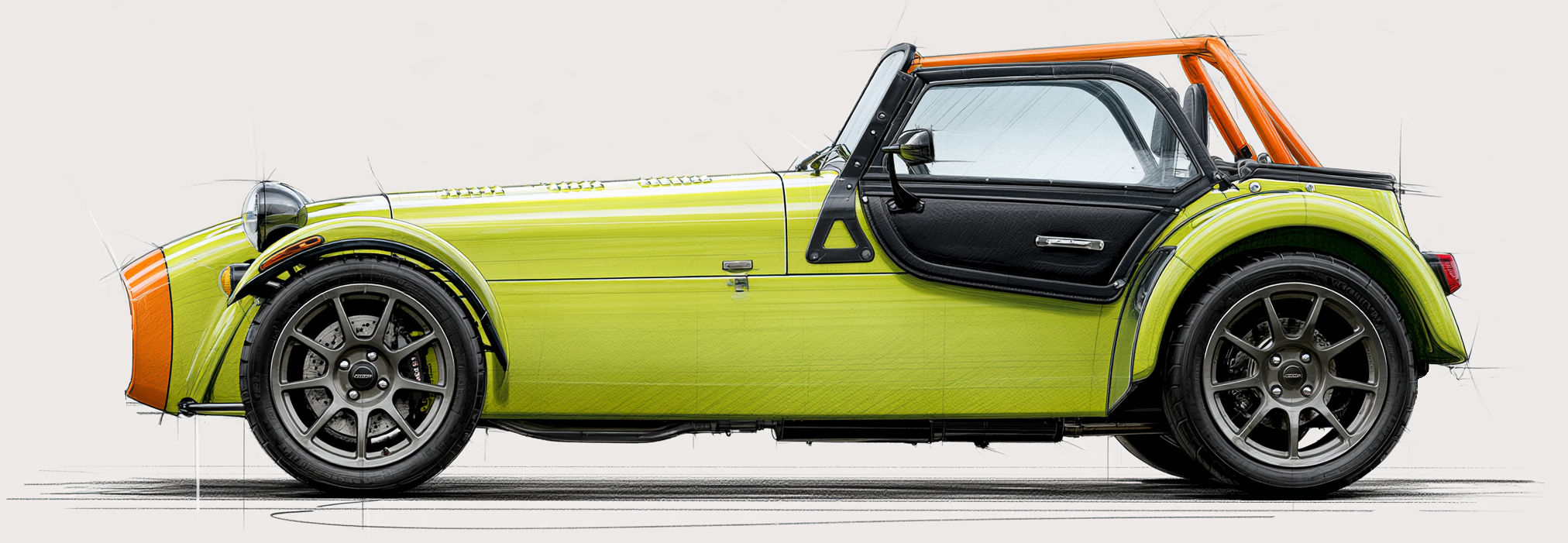
Insuring a Seven
Tuesday, Aug 04, 2026 · 1501 words · approx 5 mins to readThe Seven is the first car that I’ve ever had a bit of difficulty finding a good insurance policy for. To me, good insurance for any car has to have the right policy features and configuration for the car in question, and provide good value for money. The rarer and more expensive a car, the harder finding something good seems to be.
Not that Sevens are super rare as an overall model of car—Caterham have sold over 20,000 of them in the last 53 years—but there are certainly ways to put one together in terms of specification and modifications that very quickly makes a particular Seven rare and has it occupying a little niche. The powertrain and chassis combination of my car puts it into that category of niche, meaning that if it was to get into an accident and couldn’t be repaired, there is literally no way to use the money I’d get to replace it like for like by buying a used car on the open market. Caterham have literally never sold another one like it.
A car of any rarity will tend to have a particular relationship with higher prices. Caterham Sevens aren’t expensive when compared to other cars with similar levels of performance, or similar philosophies about what should make a car in the first place (lack of a roof, or doors, or extreme lightness, say). Compared to things like Lotus Elises and Exiges, or Ariel Atoms, they’re usually very good value for money.
However for some models in the Seven lineup, depending on specification, age, mileage and how well they’ve been looked after, prices can get quite healthy. That’s especially true if you want to buy one new. My car occupies the upper end of the Seven pricing spectrum on the used market because of the gearbox and by virtue of being a 420R, but compared to a brand new 420R SV which I’d have to put through Signature personalisation, or most used 620R and 420 Cup cars which also have the gearbox but the wrong chassis, it’s excellent value for money.
Regardless of rarity and cost, there’s also the fact that for a car like a Seven, where there’s very little physically stopping someone getting into it, because there’s no doors or roof, physical security for it is different to other cars. That’s not to say they’re frequently stolen either, far from it in fact. But it does mean that stopping people getting in and driving off isn’t a problem you tackle the same way with as other cars.
The usability of a Seven is different to most cars, too. Sevens are predominantly cars that people only use when it’s dry, which in the UK means they’re only used for about half of the year. They’re far from being daily drivers, and most don’t rack up the miles as a result. For example, in 9 years my car has covered less than 3,000 miles. That means how often they’re used, and what they’re used for when they are, also factors into the risk profile that insurance companies have to consider, and it’s a risk profile that looks nothing like most cars.
That extends into how owners of cars like Sevens typically very seriously look after and cherish them, taking great care to learn how to drive them properly, often in likeminded groups where the risks of something going wrong are lower in the herd. The average owner of a Seven has it as their main pride and joy, pouring great time, effort, care and attention into the maintenance and driving of the car in the best ways possible.
Without considering all of that in the assessment of risk, an insurer is going to assess that risk incorrectly. That’s the primary reason that it’s been so difficult to get a good policy for the car. The trick to doing so was a specialist insurance company that understands almost all of the above. There are many out there, and I didn’t talk to every single one when working out what company to go with, so the one I did pick (Howden) is undoubtedly not the very best, but they did understand the assigment well enough to offer me something in my ballpark of good enough to make me say yes.
It’s a shame that finding a company that understands the assignment takes so much time. In hindsight I should have tried them first, rather than after exhausting my patience with online searches using the most basic insurance comparison sites. Howden were recommended to me by Simon Hoade, who uses them to insure his own car, and he’d mentioned them to me a couple of months ago.
The end result, after discussing the car and the details of the modifications I plan to do during the first year, how I’ll keep it at home and what the security for my garage looks like, along with policy details like my annual mileage estimate and whether I needed add-ons such as breakdown assistance or cover outside of the UK, was a full-featured policy with less than half the annual cost and a lower excess amount of any insurer I found using online comparison sites.
They were very thorough and considered everything when figuring it out for me: my membership of the Caterham and Lotus 7 Club was a factor, for example. Why? Because car owners who belong to owner’s clubs are more likely to really look after their cars.
One huge pain in the ass using the comparison sites and big-name insurers was that many didn’t even know what a Caterham Seven is, or they couldn’t determine the correct variant of the car if they did. Some don’t even offer Caterham as a car marque. I’d type the registration number in and either nothing would come back, or the wrong Seven model variant would come back. None had the ability to correct that.
Howden’s system also couldn’t work out the fine details from the registration number, but they patiently asked me about the car with a clear knowledge of what a Seven is, building their view of it so they could go find a good policy for me using that information. The silly thing is that Howden aren’t actually the policy’s underwriter, they’re just a broker that has access to specialist insurance products that the comparison sites can’t get you to. The underwriter for my policy with Howden, Axa, sells car insurance directly, just not in a way that makes it easy for me to come to them for a policy for a car like a Seven.
There’s also more to the insurance topic for me to cover in the future, when I get the opportunity to navigate it directly. The main one is trackday insurance. Howden do have optional trackday cover that they can add to their policies, but they couldn’t offer it to me because I’ve never done a trackday before! If I get some trackdays under my belt in my first year of ownership then they’ll consider allowing me access to that cover on my policy renewal next year, I just can’t use them to insure myself on those trackdays that I do in my first year of ownership
So more about that in the future when I do my first trackday and have to navigate the insurance aspect seperately ahead of that.
There’s also agreed value cover, where you and your insurer jointly agree that the value of your car is not just the value of any other similar example on the open market at the time you need to make a claim. They also consider things like the value of any modifications and parts, and the cost of any other workmanship on the car to get those kinds of things added. There’s an agreed value aspect of the policy I have with Howden that values it significantly higher than the price I paid to buy it. There’s quite a lot to that topic that I need to figure out in more detail first, so more on that in the future.