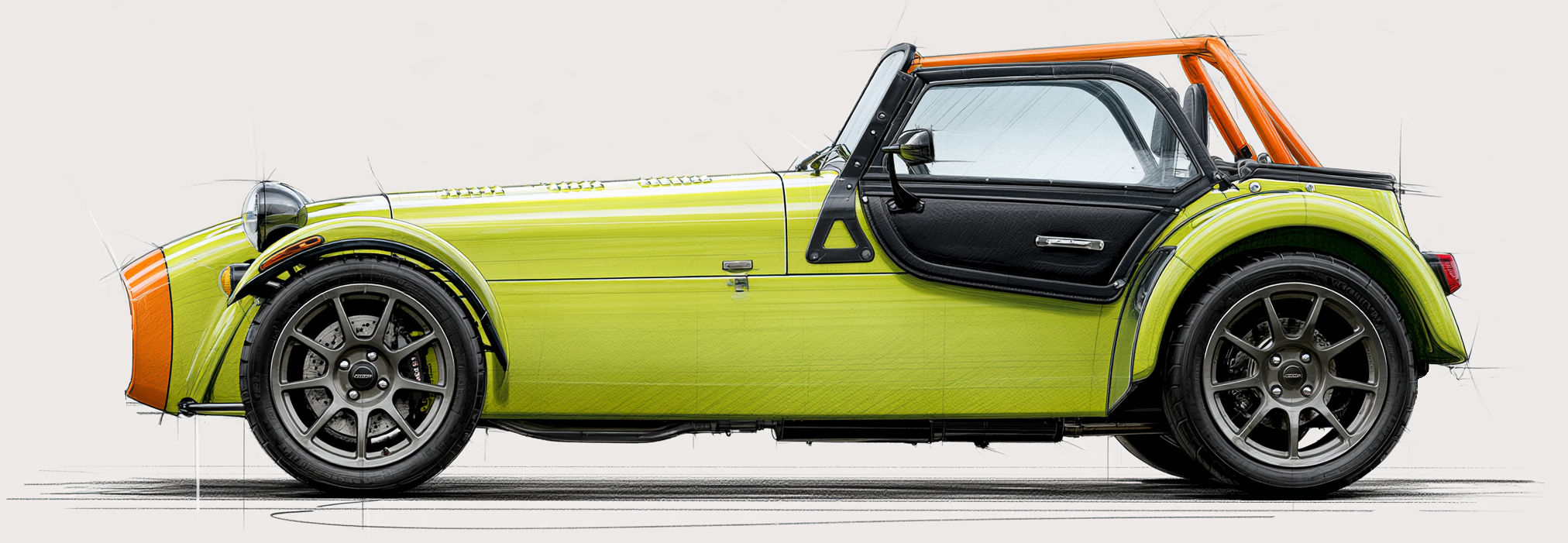
Collection day
Tuesday, Aug 18, 2026 · 2112 words · approx 7 mins to readI picked the car up today from PT Sports Cars after working with Ian and Mark at PT to figure out a good day to come and pick it up. Sorting that out was a bit more difficult than I liked, especially after waiting for so long and being very clear with PT when I expected to be able to pay the balance of the invoice and complete the sale, but we finally found a day that worked for both sides. PT are a busy company and it’s the middle of race season, and they spend a good chunk of this time of the year not on road car sales to folks like me, but on supporting customers who want to go racing across the full length and breadth of the UK.
I wanted to write down my raw early thoughts on the first 70 or so miles with the car, driving it from PT’s offices in Cookham back home here in Worthing on the south coast, especially while those thoughts are fresh. I’ve been excited for the last few weeks knowing today was likely the day, and because of that excitement and the way my brain works that today would be a little overwhelming in the moment, and therefore it’d hard to remember how I felt later on down the line.
Now that I’ve had a couple of hours to relax and decompress afterwards, I can hopefully commit the thoughts to paper here before I either forget them, or my brain rewrites them and makes them less accurate than I can process them today.
Firstly, PT had the car out in the centre of the workshop under a fitted cover, to give me that new car feeling of peeling back the cover to unveil it and cast my eyes over it for the first time in a while, since I hadn’t seen it since the initial deposit day back in May. It was such a great feeling to peel the cover back and see it again, and get very excited to not only sit in it again, but be able to drive it home. I was like a big kid at Christmas.
PT wanted a bit more time with it to fix every smaller issue but I couldn’t wait and asked for the car to be handed over with a planned visit soon to go back to remedy the last issue as they see it (a chipped windscreen).
So after sorting out the road tax for the car—which I didn’t realise was taxed at the rate for a private light goods vehicle with engine size over 1549cc, rather than the more common method of being based on its CO2 g/km emissions—and getting a quick rundown from Mark about what he saw was still left to fix on the car, I set off.
Caterhams are notorious for having what honestly amounts to a broken fuel gauge which doesn’t read accurately at all. So while the car had been given ~10L of fuel by Mark at PT just before I set off, I wanted to brim the tank before starting the main miles back home. Following my future brother-in-law who had joined me for the trip, piloting my RS 182, we headed for the first petrol station.
That meant quickly getting to grips with the clutch, flywheel and the shifter. The clutch has a really high biting point right at the top of the pedal travel, the flywheel has low mass and so not much inertia, allowing the revs to drop relatively quickly, and the shifter was completely unlike anything I’ve driven before, so I had to adapt really quickly.
I’ve done so much research about sequential gearboxes that I knew broadly what I was doing, and the test drive in May had given me a small window into what it’d be like, but that first few miles by myself were a really rapid education and very eye opening. There’s no substitute to just diving right in.
The first thing I had to take care of on that first ~5 mile drive before stopping for fuel was not giving the car too many revs before engaging the clutch. Getting used to that resulted in a couple of wiggly moments leaving junctions from a standstill as I put too much power down. My first corrected slide was bare minutes after driving away, which quickly woke me up.
The other major thing was unlearning the habit of using the clutch for every shift. Flat upshifting in a Seven with the Sadev gearbox can be done as long as there’s at least some minor application of throttle. So even just cruising along at low revs on part throttle you can pull the shifter back for the next gear without using the clutch.
The shift mechanism itself requires a much more positive action than any other H-pattern synchromeshed gearbox shifter I’ve ever driven. You have to be firm, positive and quick with your shifts. On a downshift you use the clutch as you would in a normal manual gearbox car.
Once I’d gotten into the correct habits and found my rhythm when shifting it all became much easier and felt like I was doing the right thing, and I’ve been able to seamlessly switch back and forth between the Seven and the Clio without any issue. There’s a lot more nuance to write about here, and some interesting information about moving through neutral to get between 1st and reverse, so I’ll save all that for a future post.
After filling up and finding my feet (and left hand!) with the major non-steering controls, I felt comfortable accessing a tiny bit of the performance on tap. Brand new to the car and without it being setup for me and my weight, and on reasonably old tyres that hadn’t seen real use for a long time, I wanted to be very careful on that first drive home to get it back in one piece.
The way the shift lights had been setup encouraged me to take it very easily. The first light kicked in at 3,000rpm, way below the 7,600rpm where peak power is at very top of the rev range, and all lights were maxed out at around 6,000rpm. That meant I was changing up around 5,500rpm or so, a long way before the engine in the 420R state of tune really gets going and makes the guts of its power. These engines love to be revved out, but the initial shift light configuration stopped me from experiencing the very top of the power band.
Part of the run back home was a short section of motorway, which I admit to not really enjoying. The car itself is fine at motorway speeds, with very little obnoxious buffeting in the cabin and perfect stability and road manners. It is very noisy, but that’s to be expected for a car with no sound deadening and where the driver sits almost directly on top of the exhaust exit.
The main problems on the motorway are actually with other road users: you’re so low to the ground that larger vehicles like trucks and lorries don’t see you anywhere as well, so you need to make sure to give things like that a lot more space and more chance to see you than you normally would in something much more typical on UK roads. It also made me realise that being in a normal tin top car insulates you very well from the normal smells on the road. Smelling the fumes as I passed trucks and lorries at exhaust height was a new experience for me.
I also found it tiring in some stop-start traffic I found myself in on the UK’s notorious M25 motorway on the way home. THe clutch is way heavier than in my Clio so my left leg got a workout, and lack of a heater in the initial specification of the car means that it also doesn’t have a cabin fan to get any airflow through when you’re not on the move. I think I might try and do something about that eventually, lest every hot summer’s day drive end up with a puddle of me left on the carbon Tillets.
Getting in and out feels second nature to me now at the time of writing, but those first goes on the first day were a riot of me laughing at myself and onlookers enjoying that comedy. With the particular cage my Seven has, you really want to get in and out through the top of it, not the side. Learning what you can and can’t stand on in any given Seven is a real rite of passage. The main point of order on my particular car is not standing directly on the carbon fibre seats, especially if you’re a bit of a lump like I am. They’re strong by virtue of what they’re made out of, but you still need to be careful of standing directly on them as you get in and out.
It only took a couple of goes pulling myself up to get out of the cage top after being sat in the car to realise that I was going to get stronger wrists and biceps whether I liked it or not. I’m technically writing this several weeks after the day I’m describing and I’m already noticeably stronger due to having to haul my carcass out of the car, and lower it in to sit down.
The last topic to cover in my first day thoughts is the door-mounted wing mirrors. They’re laughably bad, vibrating at speed so that everything I can see in them is a blur, and they’re impossible to adjust myself while I’m sat in the car. Even after getting help to adjust them so I could see something useful out of the driver’s side one, with the passenger side being mostly useless no matter what because of the cage being in the way, it’s so easy to nudge them out of my preferred alignment when getting in and out of the car.
The mirrors not showing me anything useful was partly to blame for a tiny accident I had on the first day, reversing the car onto the drive outside my house. I needed to reverse round the front of my Clio, clearing that to get the right angle of attack to creep onto the drive. I very quickly learned that the mirror wasn’t showing me enough of the rear wing as it very slowly scraped past the Clio’s front bumper.
Paint was exchanged at less than 1 mph and I just sat there in the seat chuckling away to myself. I’ve always known that the driving experience of the Seven would be so different that I’d undoubtedly have a bit of a bump at some point, but I didn’t think it would be 4 to 5 hours after collecting it on the first day, smooshing it up against my other car outside my house.
Getting it into the garage at the end of the day to put it to bed went better than it could have at least, as a result. I already knew by then not to trust the mirrors or my own driving skills, so I (easily!) pushed it into the garage instead. Chalk up another benefit of it being so light.
A lot has happened with the car in the weeks since the happenings on this first day with the car, but I’ve been so busy enjoying it that I’ve slowed down writing about everything. Hopefully I can pick up the pace again.